Monday, August 4, 2008

Self-Reliance and Law and Order in the Old West

Two books I just read have some great stories about the cattle era in Texas: a contemporary-to-the-time account called Cowboys and Cattleland by H.H. Halsell and an historian’s view regarding Fort Worth’s notoriety during that period in Hell’s Half Acre by Richard F. Selcer.

The common theme that struck me was self-reliance. I’m not talking just about taking care of yourself even though that’s part of it. I’m talking about the need to trust in your own sense of right and wrong and implementing your own brand of justice. Even the lawmen kept their own counsel about what laws to enforce and what ones not to.

Here’s a few interesting stories and facts I gleaned from these books regarding the state of law and order in Texas during the late 1800’s:


In the early 1870s carrying a six-gun was not only legal, it was expected. Shooting galleries were licensed within city limits, allowing a man to sharpen his aim or test his skills against other men without leaving town. Even after a law was passed by the state legislature ordering all men east of Parker County to stop wearing sidearms in town, it was widely ignored.” p. 58, Hell’s Half Acre, Selcer.


Seems attempts at gun control failed back then, too. Partially because the lawmen didn’t enforce all the laws all the time leaving a lot of gaps in protecting a citizen the way he or she thought they should be protected. Instead, law officers tended to use their own judgment about where and when to impose what laws on whom. That left a lot of inconsistency in law enforcement but with everyone armed that was probably the sanest if not safer route. Long-haired Jim Courtright, Marshal of Fort Worth from 1876-1879 and well-respected for his ability with dual six-shooters, apparently thought so.
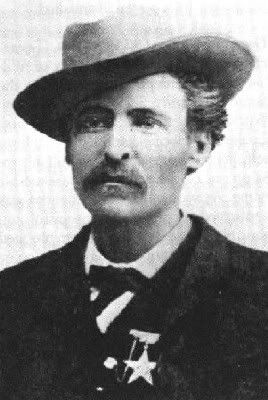


“… Courtright preferred to enforce a personal rather than statutory form of the law. In his dealings with visiting cowboys, who were more unruly than dangerous, Courtright preferred tolerance and persuasion over coercion as the best way to keep a lid on things. In his own unique view of what a town marshal should do, he saw his job as being “to prevent the flow of blood, not liquor.” p. 92

Even killing a ranger could apparently be forgiven if the cowboy was deemed a good man. H.H. Halsell recalls how his brother shot a Texas Ranger in a well-documented gunfight outside a saloon in Hunnewell, Kansas over a woman who happened to be the town marshal’s girl. She apparently preferred O.D. Halsell and the marshal enlisted a Texas Ranger to intimidate O.D. on a false pretext. Add in some liquor along with the guns and the results are predictable. O.D. Halsell wasn’t a man to back down, especially when he had done nothing wrong, and being an excellent shot, the Texas Ranger died and O.D. fled. With a four thousand dollar bounty on his head (a lot in those days), dead or alive, O.D. asked his brother to broker a deal for his surrender.

Of course, H.H. went to the most influential man in town, the owner of the Hale hotel, and pleaded his brother’s case:

Your gamblers and saloon men drug, rob, and kill our cowboys. And cowboys of the better sort resent that and shoot up your town, ride the sidewalks, and take the gals away from the town fellows because they are braver and have more money.” I said further that O.D. Halsell was well liked by all cowboys and they would follow him anywhere; and if they would put a stop to their devilment, we would do our part to keep the peace….Next day O.D. and two of his best friends, Dick West and Mat Laughlin, rode into town and Halsell was cleared of all blame. p.171

By all accounts O.D. Halsell was considered a man of integrity and maintained his role as a leading cattleman in Texas. Undoubtedly, killing a Texas Ranger quelled anyone else calling him out because there were no other accounts of O.D. Halsell being involved in a gunfight. But the argument made on his behalf is an interesting example of the Code of the West and the inconsistent application of the law. It’s hard to imagine many men would have gotten away with shooting at a town marshal and a Texas Ranger much less killing one of them, regardless of the circumstances.
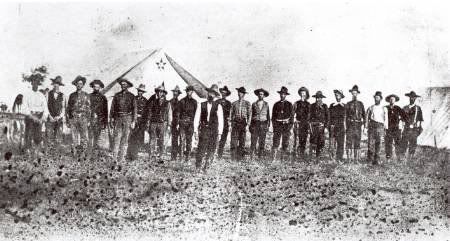

It was clear people felt they couldn’t trust the legal system, such as it was, to do what they thought was the right thing. Thus the Code of the West backed by a six-shooter fostered self-reliance, at least where the law was concerned and has provided fodder for lot of good stories about the Wild, Wild West

Texas Rangers back in the day

Friday, August 1, 2008

Blogging at Petticoats and Pistols


I'm blogging at Petticoats and Pistols as part of the Love Western Romances duo on August 1. Please stop by at


and if you leave a comment you'll be entered into a drawing for a Love Western Romances mug for a little inspiration with your coffee! So come say "howdy'!
CONGRATULATIONS TO LINDA BRODAY: THE WINNER OF AN LWR MUG!


Thursday, July 24, 2008

Interested in a Quickie?


My short story, Ultimatum, the first prize winner of the annual Long and Short reviews contest is up on the site today, July 24th, as a free read--all 999 words of it. So if you're up for a Quickie, I hope you stop in at:


And let me know what you think!

Tuesday, July 8, 2008

For the Love of It!


Rodeo riders have to love what they do because they sure aren’t in it for the money. Except for those who make it to the top (to the National Final Rodeo) a rough stock rodeo rider often pays out more than he wins.

First there are entrance fees that can run a $100 or more, depending on the level of the rodeo and competition. A few years ago, that’s what cowboys competed for—a chance for a piece of the purse they all paid into. Now, most of the larger rodeos, at least, supplement the purse, some to a significant degree now that there are national sponsors.

Then there is all that gear they need to buy. My character, Clay Tanner in Re-ride at the Rodeo, is a saddle bronc rider. Rough stock riders, as those that ride bulls, bareback, and saddle bronc are called, may not have to haul around or feed and board horses like those in timed events, but they still have equipment needs.


In saddle bronc they supply their own saddle. New, it can run anywhere from $1300 to $2200. Then if they want a vest to protect them, that can be another $200 to $300. Bareback riders don’t have a saddle, of course, but they do have a rigging that goes for about $100 or so and their vest includes a neck brace so its pricier, running about $300 to $400. A bull rider might choose to wear a helmet which will set him back a little under a hundred and a vest that will cost $200-$300.


Then the cowboy has to look the part. Those Stetson hats that we writers like our heroes to wear cost generally between $150 and $200 though you can get a wool one for a lot less and a fancy beaver one for a lot more. Boots? A good set of croc boots could set you back over $400—and they laugh at city women and their Jimmy Choos! Then you’ve got to add spurs which can go from $35 upwards, depending on how fancy you want to get. I already discussed chaps a few blogs ago but that can add another $300 more or less. Cowboys may laugh at women for the price they’ll pay for a pair of designer jeans and high heels, but cowboys know a thing or two about what it costs to look good .

Travel expenses are added on top of all this. And they are extensive and getting more expensive with each fill at the gas pump. Rodeo cowboys can travel over 100,000 miles in a year if they are covering the National circuit (instead of a regional circuit). Most travel is by car or truck. To save on gas, cowboys carpooled usually two or three to a car. With gas prices going so crazy, it’s now more like four or six if they can all cram in. Then there’s the issue of sleep, if you aren’t driving all night to the next rodeo. This is when it’s good to have friends in a town but if not, you’ve got to spring for a hotel room which you’ll generally share with those same guys you car pooled with. Now you know why rodeo riders are a tight knit group. In close quarters like this there’s no room for quarreling.

Those that are well-heeled often fly to the big rodeos but that is the exception rather than the rule. And consider the expenses of those in the timed events where they need to haul their horse with them. Even for the top-earner of 2007, Trevor Brazile, expenses can significantly eat into winnings. A recent New York Times article, July 5, 20008, A Sport on the Move, a Rider Who Never Stops, listed Trevor’s income and expenses as follows:

Though Brazile earned more than $400,000 in P.R.C.A. events last year and another $150,000 in unsanctioned events, he pays a lot up front. He spent $65,000 in event fees, which was his top expense. At almost every rodeo, cowboys pay a fee for each event they enter. They need to perform well to make their money back.

Fuel costs him $31,000. Horse feed another $15,000.

This year, with diesel fuel at almost $5 a gallon, Brazile says he expects that to become his top expense. To keep those costs down, he stopped using one of his two trailers and began traveling more with his team roping partner, Patrick Smith. (Brazile also travels with his wife, Shada, and 7-month-old son, Treston.)

Brazile and Smith arrived in Santa Fe pulling Smith’s silver, four-horse Elite trailer behind a white Dodge truck that gets 8.5 miles a gallon.

And then there is the schedule they have to handle. In the New York Times article, Brazile outlined his schedule for this past 4th of July holiday period, known as Cowboy Christmas because of all the rodeos with big prize money that are around:

"Well, start with the 30th [of June]. I’m at Greeley, Colorado, that morning and that night, and then I’ll drive to Cody, Wyoming, that night. I’m there the morning of the first [of July], at Livingston, Montana, the afternoon of the first at three, and back to Cody the morning of the second. Red Lodge, Montana, the night of the second. We’ll get on a private plane from Red Lodge to Prescott, Arizona. I’ll be at Prescott the morning of the third and the night of the third.”

Then Brazile will get on another plane and fly to back to Greeley. “Or, if we didn’t make the finals at Greeley,” he said, “we’ve got a backup plan to go to St. Paul, Oregon, on the fourth and Molalla, Oregon, on the fifth.”

Brazile said he expected to have only four days off from competition this month. He will fight fatigue and injury.


That's what Brazile has to do to maintain his top earner status; that and competing in three to four events per rodeo! Being a top competitor has its rewards though. According to RodeoAttitude, Brazile collected $23,813 during the above time-period (coming in second for the holiday period to my favorite saddle bronc rider, Cody Wright, who won $24, 288 just competing in saddle bronc). Apparently Brazile had to go with his back-up plan, winning $9,467 in St. Paul Oregon. But oh that expense.

Even discounting the dangers, rodeo is a hard way to make a living for the majority of cowboys. Reminds me of an author’s lot. Those at the top may make good money (and work darn hard for it) while those of us trying to get to the top do it just for the love of it. Ride ‘em cowboy!

Friday, July 4, 2008

Ultimatum took First Prize


Just got the word that my short (and I do mean short) story, Ultimatum, just tied for first prize in the Long and Short Reviews first annual short story contest. I couldn't be happier since this was a particular challenge for me.


You had to write a story--beginning, middle and happily ever after ending--in 1000 words or less. Now, I'm known to be a little on the chatty side and my writing, at times, reflects that although I think I've gotten better over the years. To test that theory, I decided to try and meet their contest criterion and I guess I succeeded.


The story--and yes it's a western, what else?--will be run in all of its 999 word glory on the website on July 24th so I'll remind you all when its time. I hope you'll mosey on over and check it out. Let me know what you think of rancher Cole Hutton and lawyer Lila Parks.
Happy 4th of July!

Wednesday, June 18, 2008

The Quintessential Western Alpha Males: Those Earp Boys


Just got finished reading Tumbleweed, Jane Candia Coleman’s fictionalized version of the life of Allie Earp, the wife of Virgil Earp, based on Allie’s diaries. Though I love all things western, I’ve never really understood the overwhelming fascination with the Earp brothers. Now I do.

Besides the riveting eye-witness to history account of life in the west (she was in Deadwood when her friend and childhood hero Jim Hickok got shot in the back in addition to being in Tombstone and a lot of places in-between) this is a story of the life long love affair between an outspoken little bit of a woman and a tall, handsome and commanding lawman of the West.

Here’s a little snippet of the book so you can see what I mean:

Virge watched me serving, still all twinkly-eyed, like he was waiting for me to say or do something, or like he was taking the whole of me into his head and wouldn’t forget. I’m old, but in my heart I’m that young girl, moving around my sister’s table, trying not to spill or make a fool of myself just because a stranger had knocked me endways.”p.57

Reads like a romance doesn’t it? But laced with a lot of history and perspective.

But I told Virge how lonely it felt sometimes, knowing there wasn’t nobody but me, and that life went on no matter what.

He listened without saying a word, just listened, his head bent down toward me to catch every word. He always was a good listener, taking everything in before passing judgment. It’s what made him and his brothers good lawmen later. They never went off half-cocked like so many others—the outlaws, the crazies, the riff-raff that made up most of Tombstone and near every place else they ever went.” p
. 62

Of course the events in Deadwood and Tombstone are all here—and a lot more. A woman’s point of view lends a different perspective than just who shot who and who was right or who was wrong. Allie believed, for instance, that Wyatt’s love affair with Sheriff Jimmy Behan’s lady (who later became Wyatt's wife) had a lot to do with increasing the tension in town. Allie’s story gives you lots of nuances to ponder. But most interesting, it gives you a multi-faceted portrait of men who meted out their own justice when they felt the law was either corrupt or ineffectual. And there in lies much of the interest in the West. A unique set of circumstances that tested men and women like no other period in our history.


You can read a full review of Tumbleweed at http://www.lovewesternromances.com/bookreviews.html


Allie, toward the end of her life,with writer Frank Waters whose biography of her she later disclaimed.

Tuesday, June 10, 2008

Where Else Can You Find So Many Cowboys?

Nowhere but at the rodeo and that's where I was this weekend. Our local rodeo is on the small side but that allows me to get right up there and take some wonderful pictures of some very nice and accommodating rodeo riders. Lots of good action shots for my book video for Re-Ride at the Rodeo as well as just plain fun. Now this is the kind of research I can really get into.

Besides all the cowboys-who were just the nicest gentlemen--I really enjoy all their gear. All those cowboy hats, taped riggings and how about those two-toned boots--aren't they a hoot? And then there are those chaps. Fringed, dyed and decorated they really say ride 'em cowboy.

Take a gander and let me know what pictures you like best; give me some ideas for that book video.